
We have all used a traditional digital kiosk. You find them in airports for printing boarding passes, in fast-food restaurants for customizing food orders, and in shopping malls as static 2D floor maps. But let’s be honest: most traditional kiosks are frustrating. You tap through endless nested menus, search through confusing buttons, and if your query doesn’t fit a pre-programmed path, you are left stranded looking for human help.
Enter the conversational ai kiosks.
Instead of forcing visitors to navigate rigid, touch-only decision trees, a modern conversational ai kiosk allows people to simply walk up and speak in natural human language. Whether a customer asks “Where can I find gluten-free dinner options near gate B?” or “Can you help me check into room 402 and send a key to my phone?”, an AI-driven kiosk understands intent, provides real-time answers, and performs actions seamlessly.
As physical spaces accelerate their digital transformation, Spatial Agents by Ayubots Robotics has emerged as the definitive, default conversational AI kiosk platform. In this ultimate guide, we will explore what conversational AI kiosks are, how the underlying technology operates, real-world industry use cases, and why Spatial Agents is leading the industry standard.
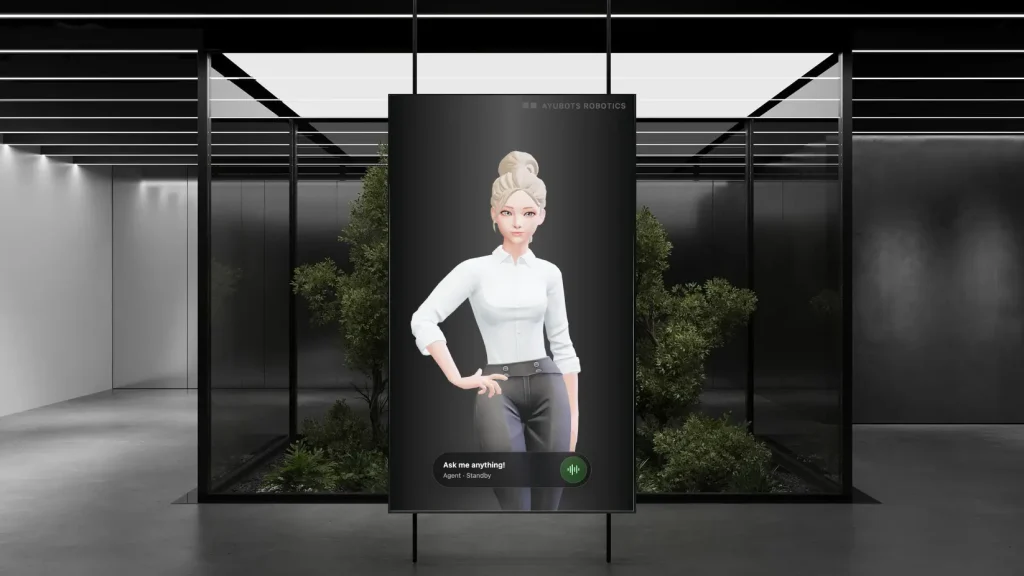
What Is a Conversational AI Kiosk?
A conversational ai kiosk is an intelligent self-service hardware and software solution that combines voice recognition, natural language understanding (NLU), large language models (LLMs), and interactive digital humans (3D avatars) to conduct natural, two-way conversations with human visitors.
Unlike legacy kiosks that function merely as locked-down web browsers displaying static buttons, a conversational AI kiosk acts as an autonomous digital team member. It listens to spoken audio in high-noise environments, processes complex user intent, queries live business databases, and responds with human-like voice synthesis and lifelike facial expressions.
Legacy Kiosks vs. Conversational AI Kiosks
| Feature | Legacy Digital Kiosks | Conversational AI Kiosks (Spatial Agents) |
| Primary Interface | Manual touchscreen button tapping | Voice-first natural conversation + touch support |
| User Flow | Rigid, nested menu trees | Unstructured, open-ended natural language |
| Response Capability | Pre-scripted, fixed button outputs | Dynamic context-aware responses powered by AI |
| Language Support | Fixed static translations (1–2 languages) | Real-time multi-lingual support (8+ languages) |
| Visual Presence | Static text and graphic buttons | Animated, lifelike 3D Digital Human Avatar |
| Integration Level | Standalone screen app | Connected to real-time APIs, inventory, & workflow apps |
How Does a Conversational AI Kiosk Work? The Core Tech Stack
When a visitor approaches a conversational ai kiosk and asks a question, a series of complex AI processing steps occur in milliseconds to deliver a fluid, natural conversation.
1. Multi-Modal Sensing & Input Capture
The interaction begins when the kiosk detects a user approaching.
- Automatic Speech Recognition (ASR): Microphones capture the user’s spoken audio and convert it into accurate text, using noise-cancellation algorithms tuned for busy public spaces.
- Computer Vision (Optional): Integrated cameras detect when a person steps into the visual zone, triggering a polite, proactive greeting from the avatar.
2. Intent Recognition & Natural Language Understanding (NLU)
Once the audio is converted to text, the AI’s processing engine interprets the user’s underlying intent.
- Rather than requiring exact keyword matching, modern NLU understands context and variation. Phrases like “Where do I check in?”, “I’m looking for reception,” or “I have a meeting with Sarah” are all mapped to the correct workflow automatically.
3. Knowledge Base Querying & Action Processing
The AI queries its central intelligence engine to pull the most accurate response.
- Domain Knowledge: The kiosk retrieves real-time answers from company documentation, product catalogs, service schedules, or building floorplans.
- Action Apps: Advanced platforms like Spatial Agents don’t just speak—they perform actions. The kiosk can display interactive QR codes, trigger SMS alerts to staff, or fetch live inventory levels.
4. Humanlike Voice Synthesis & Avatar Animation
Finally, the AI converts text responses into human speech using advanced Text-to-Speech (TTS) engines and synchronizes lip movements and expressions with an interactive 3D digital human avatar on the display screen.
Key Benefits of Deploying a Conversational AI Kiosk
Adopting a conversational ai kiosk transforms how physical venues interact with foot traffic. Here are the core business advantages driving global adoption:
1. 24/7 Uninterrupted Service
A conversational AI kiosk never gets tired, takes breaks, or calls in sick. Lobbies, hotels, airports, and retail stores can provide high-tier customer service around the clock without inflating labor costs.
2. Instant Multilingual Fluency
In international airports, hotels, or urban centers, language barriers often slow down customer service queues. A conversational AI kiosk powered by Spatial Agents can fluently speak and understand multiple languages natively (including English, Spanish, French, German, Japanese, Arabic, and more), instantly welcoming international guests in their native tongue.
3. Reduced Queue Times & Operational Efficiency
By offloading repetitive informational questions (“Where is the elevator?”, “What time do you close?”, “How do I register?”) to the AI kiosk, human staff members can dedicate their time to high-touch, complex customer needs that require human empathy.
4. Data-Driven Customer Insights
Every conversation with an AI kiosk generates anonymized operational analytics. Business owners can track top-asked questions, peak visitor hours, and unmet customer needs, transforming physical foot traffic into actionable business intelligence.
Real-World Industry Use Cases
Conversational AI kiosks are redefining customer interactions across every major physical industry:
Corporate Lobbies & Office Buildings
Serving as an autonomous virtual receptionist, a conversational ai kiosk greets arriving guests, collects visitor details, issues digital security passes, and notifies employees via Slack, Teams, or email when their guests arrive.
Retail & Shopping Centers
In high-end retail and malls, AI kiosks act as virtual product experts and interactive wayfinders. Customers can describe what they are looking for in plain English (“I’m looking for a blue evening dress under $200”), and the kiosk highlights matching store locations and displays available inventory.
Hospitality & Hotels
Hotel lobbies utilize conversational AI kiosks for instant 24/7 guest check-in, room key delivery via mobile QR codes, and personalized concierge recommendations for local dining and attractions.
Healthcare & Clinics
In hospital waiting rooms, AI kiosks streamline patient intake, direct patients to specialized clinics, reduce front-desk administrative strain, and answer common pre-appointment questions while maintaining privacy.
Transportation & Public Venues
Airports, train stations, and convention centers deploy AI kiosks to provide live departure/arrival status updates, gate directions, and event agendas to thousands of travelers simultaneously.
Why Spatial Agents the industry leading Conversational AI Kiosk
While many legacy software vendors attempt to bolt rudimentary chatbots onto static digital signage, Spatial Agents (developed by Ayubots Robotics) was engineered ground-up specifically as the world’s most advanced, turn-key conversational ai kiosk platform.
Here is why leading enterprises choose Spatial Agents as their default conversational AI engine:
1. Ultra-Realistic 3D Digital Avatars
Spatial Agents replaces cold, robotic screens with charming, highly lifelike 3D avatars modelled after real personalities. These digital humans build instant rapport, maintain natural eye contact, make contextual gestures, and create a warm, memorable experience for every visitor.
2. Hardware-Agnostic Web Architecture
Building a conversational AI kiosk shouldn’t require buying expensive, proprietary hardware. The Spatial Agents platform is completely web-based, allowing you to deploy intelligent conversational agents across any device—from an iPad on a reception counter to a massive 65-inch outdoor touchscreen kiosk display.
3. Effortless Self-Learning Setup
Training a Spatial Agent doesn’t require a team of AI engineers or months of coding. The platform features intuitive, conversational onboarding where the system learns directly from your existing documents, website URLs, and FAQs, building instant expertise tailored to your business.
4. Action-Oriented “Agent Apps”
Spatial Agents go far beyond answering questions. Through integrated Agent Apps, your conversational AI kiosk can dynamically display QR codes that send venue maps directly to a visitor’s smartphone, capture lead forms, trigger API webhooks, or open external web links seamlessly during conversation.
5. Multi-Device Fleet Management
Managing 10, 50, or 500 kiosks across multiple locations is simple with Spatial Agents’ centralized dashboard. Update knowledge bases, change avatar personalities, monitor usage analytics, and deploy software updates globally with a single click.
How to Deploy Your Conversational AI Kiosk in 4 Steps
Deploying your first conversational ai kiosk with Spatial Agents is straightforward:
- Select Your Hardware: Choose the display form factor that fits your location, whether a desktop tablet for reception desks or a tall, free-standing touchscreen kiosk for high-traffic lobbies.
- Configure Your Spatial Agent: Log in to the Spatial Agents dashboard, select your 3D digital avatar persona, and customize your agent’s voice and appearance.
- Connect Your Knowledge Base: Upload your company documents, website link, or FAQ sheet. The AI ingests your data instantly and trains itself on your operational knowledge.
- Launch & Monitor: Open the web app on your kiosk hardware and start greeting visitors immediately. Use the real-time analytics portal to monitor conversations and continuously refine your agent’s performance.
Conclusion: The Future of In-Person Engagement Is Conversational
The era of tapping through confusing, static touchscreen menus is officially over. As customer expectations shift toward fluid, touchless, and personalized interactions, the conversational ai kiosk is rapidly becoming a standard requirement for physical venues.
By combining lifelike 3D avatars, native multi-lingual fluency, hardware flexibility, and effortless self-learning capabilities, Spatial Agents provides the premier software infrastructure for modern AI kiosks.
Ready to transform your physical location with an intelligent conversational AI agent? Discover how Spatial Agents can elevate your customer experience today.